


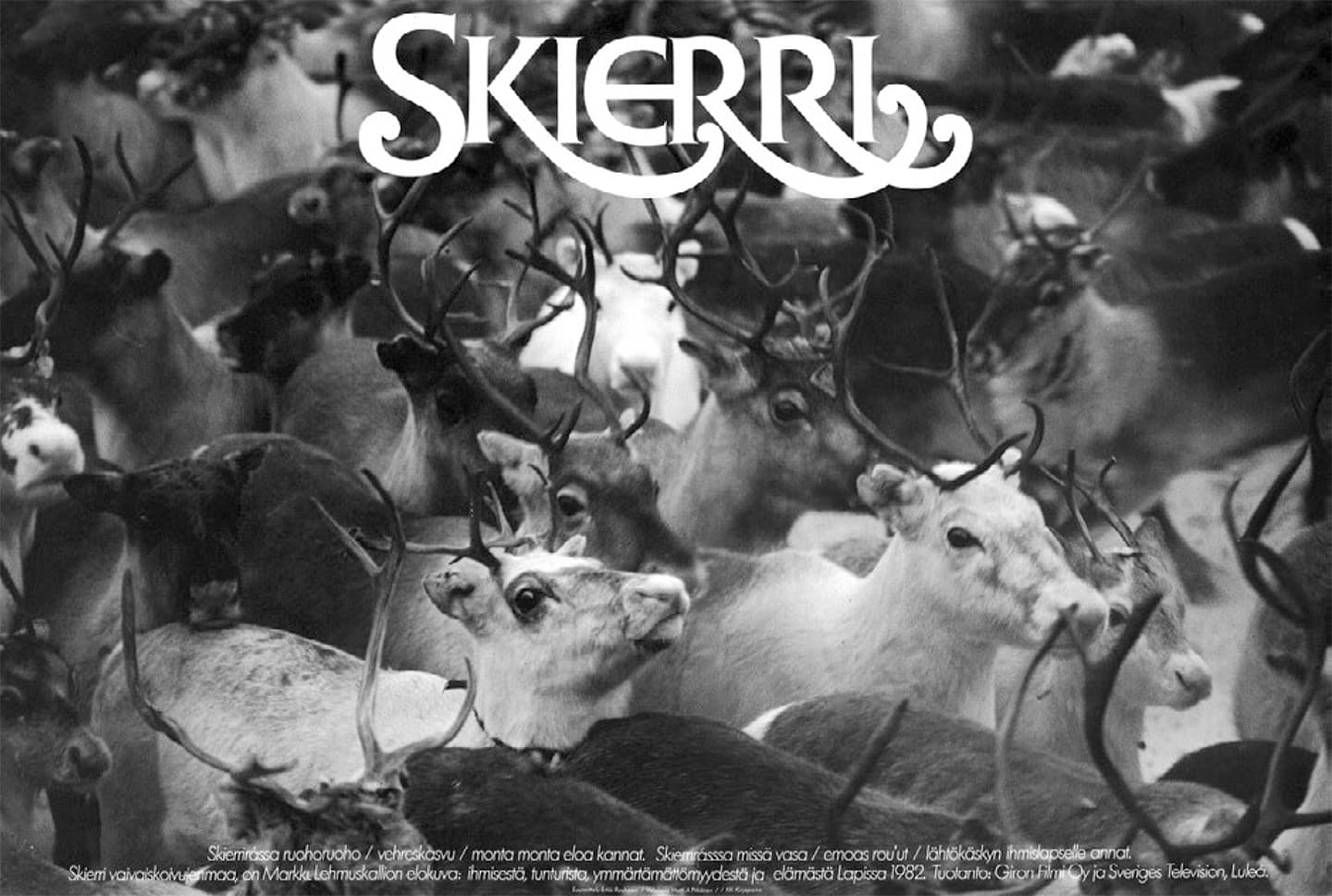
Markku Lehmuskallio was born in 1938 in Finland into the family of a sea captain. During his work as a forest technician between 1964 and 1969, he was introduced to filmmaking while creating instructional movies. He left his job to continue directing industrial films before making his first independent short in 1973. Also as a notable cinematographer, he shot Pulakapina (1977), by Mikko Niskanen.
His first feature, Korpinpolska (1980), entered the Berlinale’s main competition: a rare international breakthrough for Finnish cinema of the time. He made three more features in the following decade, including one in the Sami language and another in sign language. Peter von Bagh described him as “the consummate cinematic observer of nature and alternative lifestyles.”
Lehmuskallio visited the Soviet Union in the late 1980s to work on the anthropological project Minä olen; that was where he met Anastasia Lapsui. A native Nenets, born in 1944 into a nomadic family on the Yamal Peninsula, she had been the first indigenous radio journalist there. They became partners in life and in cinema, and dedicated their lives and their work together to the indigenous peoples of the North.
The Nenets saga occupies a special place in their filmography: Lapsui was able to describe her people from a perspective that had previously been unthinkable. New Zealand filmmaker of Māori descent Barry Barclay coined the term Fourth Cinema to describe the indigenous cinema, to which Lapsui and Lehmuskallio collaborations can be attributed. The name of their company, Giron, translates simply from the Sami language: “partridge”.
The diversity of peoples and cultures portrayed in their films corresponds to the richness of approaches to the art of cinema. This first complete international retrospective, which celebrates fifty years since the beginning of their filmography, is far from being monotonous, presenting a collection of various possibilities of documentary cinema and its methods: classic documentary, elements of fiction, animation, anthropological study and poetic visual journeys. Heirs to Flaherty at first, they created their own universe, which doesn’t have many counterparts.
One may recall the work of António Reis and Margarida Cordeiro, who preserved the disappearing and always searched for new forms of cinematic expression. In Lapsui and Lehmuskallio’s films, Cranach’s painting and cave art, Nenets fairy tales and verses by the Japanese poet Tsurayuki, Meredith Monk’s music and Sami rap coexist on equal terms. Like the Portuguese duo, they deal with culture and art without seeing them as framed by institutions or divided into the supposedly naive and professional. Art, rather, is a necessity, a part of human life and destiny. Perhaps it is, to some extent, also a counterbalance to the destruction brought by humanity.
Special thanks to Olaf Möller, without whom the idea for this retrospective would not have come about. Thanks also to Andrei Kartashov, Ekaterina Kalinina, Aleksei Nelepo, Graham Swon, Antti Alanen, Timo Malmi and Valtteri Lepistö for their help and support. The book Kadonnutta paratiisia etsimässä [In Search of Paradise Lost] (2009), by Sakari Toiviainen, and Anastasia Lapsui’s autobiography, Chto ostalos’ za kadrom [What Remained Behind the Scenes] (2007), were used as an indispensable source of information for researching Lapsui and Lehmuskallio’s cinema, as well as the writings by Caroline Damiens and Kathleen Osgood.
—
Boris Nelepo
Curator of the retrospective