


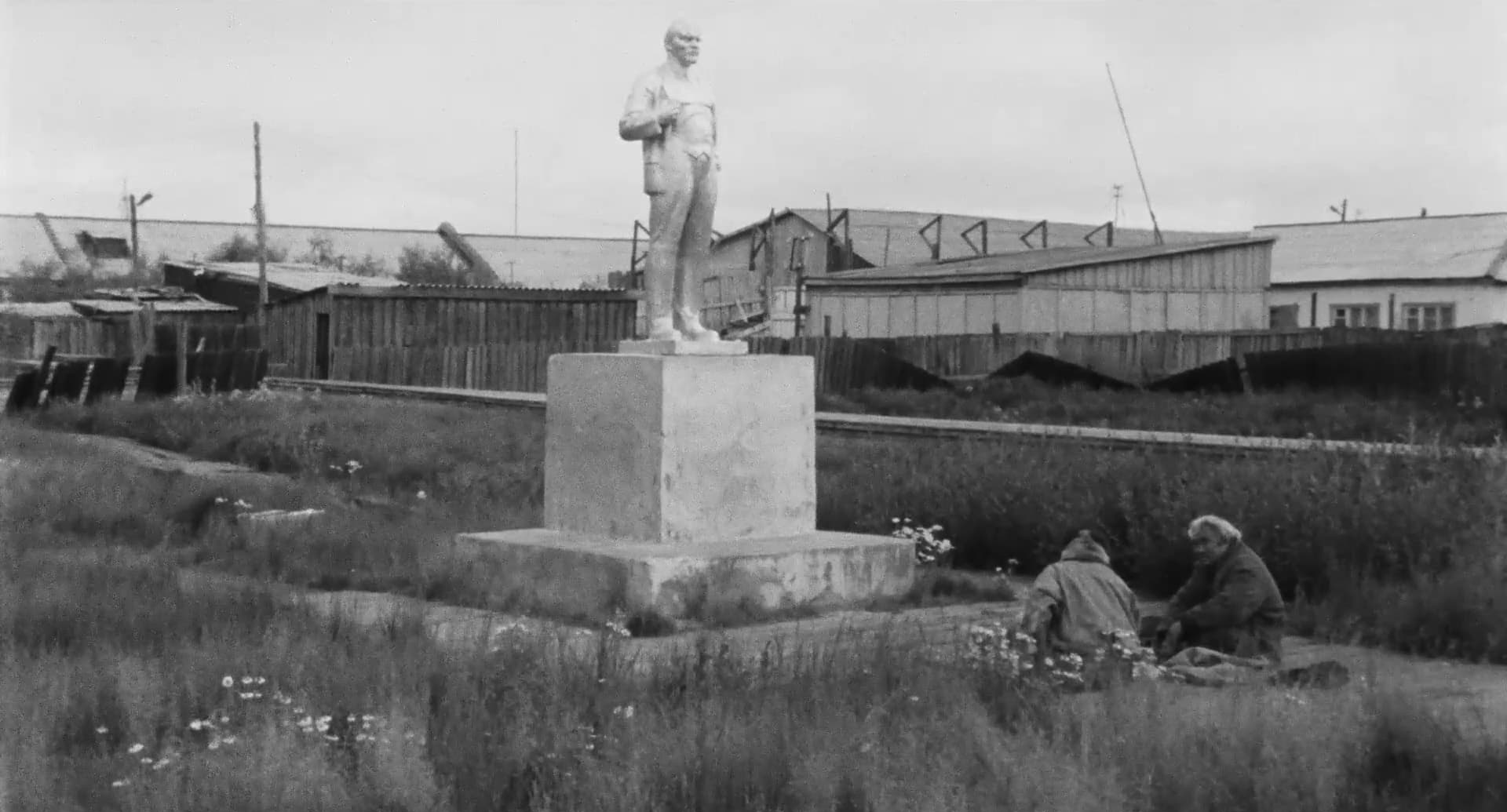
During the Retrospective Anastasia Lapsui & Markku Lehmuskallio Doclisboa is showing Seven Songs from the Tundra (2000), the first ever fiction in the Nenets language, on 25th of October at 22:15 in Cinema São Jorge. This short story by Anastasia Lapsui inspired the chapter “God” from the film.
—
Before the Soviet Union collapsed, there was hardly a place in the country without a monument to the chief of the world proletariat. The modest township of Nyda also boasted an imposing full-sized statue of Vladimir Ilich Lenin. We middle school students—all members of the Young Pioneers and the Komsomol—planted some trees around the monument and fenced it in to protect the grass and foliage from the cows. Proud of our small park, we delighted in watching the willows and alders bloom and gain strength. It was there that all the Young Pioneer ceremonies took place. I was still a schoolgirl back then, always neatly dressed in my uniform with a white apron. After all these years I still remember one story from the life of our Young Pioneer troop that proudly bore the name of the teenage martyr and Hero of the Soviet Union Zoya Kosmodemyanskaya.
I remember us, the students of the Nyda Boarding School, arranged in formation. The principal took the floor. We were too young to make much sense of his long speech. Then he got us to say several times out loud, all together: “Lenin is not a god! Lenin is the chief of the world proletariat!”
When I grew up a bit and became a radio journalist, I found out from my fellow townsman, the old Tapoy Salinder, what the occasion for the gathering was. He recalled that he and his friends—Arka Tior, a World War II veteran who defended the sieged Leningrad, and Tokhe Valak, a tundra native who had laboured on the home front—had made a sacrifice in front of Lenin’s statue ahead of the spring and summer fishing season.
“We brought hot tea and some cups from home; naturally, some vodka was also needed for a sacred occasion. We arranged the food on dishes, poured the vodka into glasses and the tea into cups. We put it all right in front of Lenin, so that he could smell the food”, Tapoy Salinder shared his recollections.
“Do you remember the battle for Leningrad, the fighting for Vesely village?”, Arka Tior asked him all of a sudden.
“God only knows how we made it out alive. I remember the place,” I said.
“Before every battle, I poured out a half of my daily norm of vodka on the ground,” Arka said. “I prayed to him and to our gods. It was his city, after all, that we defended. Perhaps he was somewhere near, walking on the ground where our trenches were.”
“Who among us did not pray?”, I said. “We broke through the blockade with his name on our lips. I think his soul was leading us forward.”
“While we back here were fishing day and night, we’d send the best fish to the troops with the words ‘all for the frontline, all for the victory’,” Tokhe Valak put his word in. “The women were making warm clothes: leather boots, coats, fur hats.”
“So we were sitting there peacefully, immersed in our memories. After a while it was time to begin the feast; according to the old customs, the first glass of vodka is, of course, offered to the one whom the sacrifice is for. We were sitting around Lenin’s statue, so he was the one. I tried to put a glass to the chief’s lips, so that he would receive the offering from my own hands, but I wasn’t tall enough,” Tapoy recalled with a smile.
“Pour it out on the ground, and it’ll reach him from there. His soul is among us,” Valak reassured me.
“How could it be otherwise,” Arka Tior said. “He sees every valley, mountain, sea and river, his sight stretching across the whole Soviet Union.”
As we sat down to eat and poured some out to the great Lenin’s health, the Party’s local committee’s first secretary, comrade Antonov, came passing by. He approached us.
“What are you all doing here?”, Antonov inquired cheerfully. “Did your wives kick you all out from your tents?”
“Come have a seat with us. We, the Nenets, always make sacrifices to our gods before the spring fishing season. We ask for their help and support, so that the fish will be plentiful, the weather serene and our families healthy. He is a god! A god of all people on earth,” Arka Tior began to tell the uncomprehending secretary. He spoke the best Russian among us.
“He’s not a god. He’s the chief of the world proletariat,” Antonov said.
“Prolaried, proletaried… You can say that in your office. Here’s what I’m going to say. Tapoy here can confirm my words. He’s more than a friend, he’s more dear to me than my own brothers. He and I defended Great Lenin’s city side by side. We clung to each other, we shared our daily bread with each other. It was hard. But, no matter how hard you try, you need something else to overcome the enemy. And finally the wait was over! The officers told us: ‘We just received the order that we’d been waiting for. Today we’re going to break through the blockade of Leningrad!’ We lunged into combat under constant fire, roaring ‘hooray’, not losing each other from sight as we were running: who knows what can happen. My friend and fellow landsman, Tapoy, is running in front of me. Suddenly he’s waving his arms, as if he were calling for me. I reach him and he falls on the ground. That was near Vesely,” Arka Tior says. “What can I do to help him? My fellow Nenets is dying. My heart filled with blood, and everything went hazy in front of my eyes. How can I help him? I can only pray. I summoned all the gods. And then I realized to whom I needed to pray. I cried out loud into the sky so that he could hear: ‘Dear Lenin, your soul is all-powerful, your heart is generous, help him so that he keeps breathing!’ So do you see now? And you’re here talking about…”
“I understand, I understand, but don’t do this anymore. What if all the fishermen start coming here to do the same? Lenin isn’t a god, he’s a chief.”
“We reckoned Lenin was the true god,” we said, taking the dishes from the pedestal.
And then the trees, apparently, felt that other winds were blowing, withered, and died away. The sand won out over the green summer grass.
—
Anastasia Lapsui
In Severyane, no. 2, 2015, Yamal. Translated from Russian by Andrei Kartashov.
This short story inspired the chapter “God” from the film Seitsemän laulua tundralta [Seven Songs from the Tundra].