


During the Retrospective Anastasia Lapsui & Markku Lehmuskallio Doclisboa is showing Anna (1997), the first film signed by both directors, on 24th of October at 22:15 in Cinema São Jorge. The curator of the retrospective Boris Nelepo explains in-detail the place of this work in the context of the duo’s filmography.
—
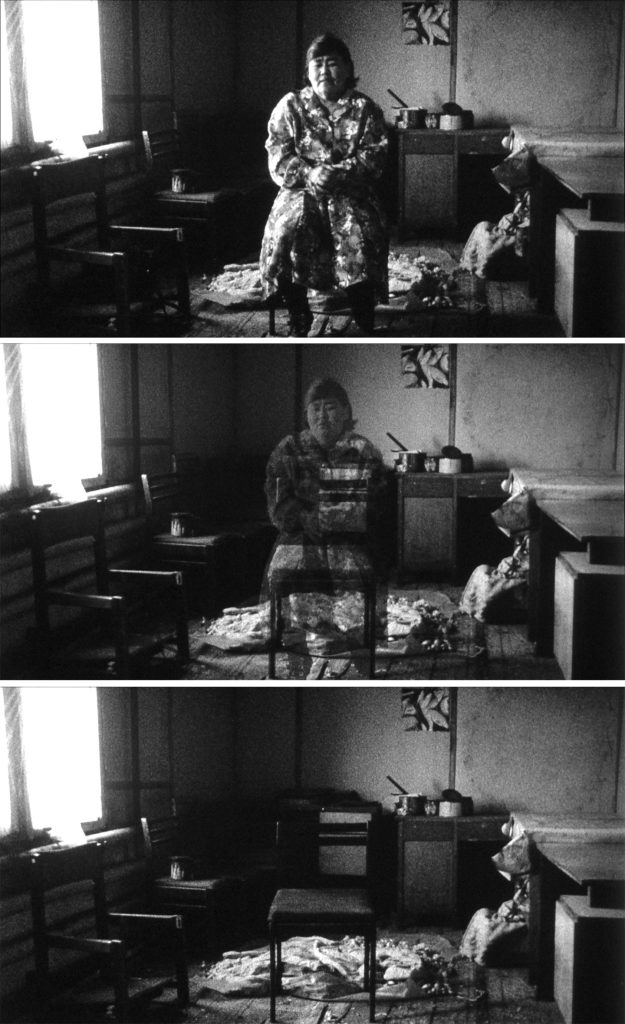
These are three stills from the film Anna. The protagonist represents the Nganasans, the second people in history to settle in high latitudes. Today there are less than eight hundred of them left. Lapsui and Lehmuskallio often employ the dissolve in their films to achieve the effect of a person simply disappearing into thin air. The technique may be simple, but laden with emotion, especially in the context of their entire artistic project.
In 1996, Anna, accompanied by the directors, visited an abandoned school and the office of the state deer farm where she once worked as a secretary of the Communist Party’s local cell. The school is one of the filmmaking duo’s key settings. It is the place where their characters, like Anastasia Lapsui herself in her childhood, were taken away from their tents, forcibly Russified, but also given an education. The two decaying buildings in Anna are a bitter postscript to the educational project of the Soviet Union, which broke down old indigenous customs before breaking up itself, leaving these people without their new identity, which disappeared with the advent of capitalism.
Cinema by its very nature captures people in the process of disappearing, but Lapsui and Lehmuskallio’s camera repeatedly found itself in places where they could still preserve the passing world, at least on film. The Sami would nevermore live the life as depicted in Skierri – vaivaiskoivujen maa (1982), and neither would the Nenets, as seen in the last year of the Soviet Union’s existence in Poron hahmossa pitkin taivaankaarta… (1993).
In her book Chto ostalos’ za kadrom [What Remained Behind the Scenes], Anastasia Lapsui recalls Lehmuskallio’s words about the conception of Minä olen: “As I began working on the film, I went deeper and deeper into history. At a glance, their art seemed like dispassionate sculptures, images from a century ago. Museums have put their mark on these works that now serve as landmarks. I could only see them and contemplate from the other side of the showcase glass. I could not touch them, I could not feel the warmth left by their creators.”
Isn’t this a key to understanding these films? The images captured by the directors are a true treasure for them, a reminder of a lost paradise, of yet another disappearance.
Perhaps this is why, in their films of recent years, Lapsui and Lehmuskallio revisit their older works so often, as if they were visiting their own visual museum full of living faces. Yes, faces: if we are discussing techniques, one fundamentally important aspiration of the directors is to film portraits, to gaze into their characters and memorise their names. And also to keep coming back to them as companions and friends, and maybe even collaborators. In the recent Anerca, elämän hengitys (2020), we meet Anna once again: unchanged, disappeared a long time ago.
—
Boris Nelepo