


New Doclisboa film series available on CaixaForum+
CaixaForum+, the cultural platform of the ”la Caixa” Foundation, launched in Portugal with the support of BPI, is now offering a selection of 11 films that were featured in past editions of Doclisboa.
This Doclisboa series on CaixaForum+ is free to access, as is all audiovisual content and podcasts on this platform dedicated to cultural themes: music, visual and plastic arts, performing arts, cinema, history and philosophy, science, architecture and design, and literature.
The selected films allow us to reflect on what it means to be alive—ranging from theater to political movements, from literature to the built environment, from classical music to urban landscapes and their inhabitants.
Available films:
In Medias Res In the Midst of Things, by Luciana Fina (2013 | Portugal | 72’)
“To enter into a dialogue with the architecture and the poetics of Manuel Tainha means not merely to chime with drawing, space and light, but also with movement, with the time and the life that inhabit it. The words of Manuel Tainha lead me through some of his works, conceived between the 1950s and the 1970s, filmed today, at one point of its existence.” — Luciana Fina
Time/Space, by Tiago Afonso (2013 | Portugal | 70’)
Tempo/Espaço records a series of activities based upon the motto of Memórias do Cárcere [Memories of Prison], by Camilo Castelo Branco, at Guimarães Prison for six months. Our long visits to that prison allowed us to explore other details – tattoos, peepholes, locks – on a day-to-day basis somewhere in the border between observational documentary and provoked actions.
8816 Verses , by Sofia Marques (2013 | Portugal | 78’)
It took Luís Vaz de Camões roughly 20 years to write the 8816 verses that compose his epic poem – Os Lusíadas [The Lusiads]. The portuguese actor António Fonseca devoted four years of his life to make them his own. For over a year, Sofia Marques followed and documented António’s experience up until the integral presentation of Os Lusíadas in June 2012 at Guimarães – European Capital of Culture.
Lisbon Revisited, by Edgar Pêra2 (014 | Portugal | 62’)
An oneiric journey seen through the amazed eyes of a trans -human, and a kino -symphony of voices from the multiple personas of the Portuguese poet and thinker Fernando Pessoa. “To think is to be eye -sick”, said Alberto Caeiro, the most sensorial of them. Lisbon Revisited lives through this sickness, showing alternative ways of looking (at the city) and hearing (Pessoa). The title comes from a poem by his futuristic heteronym, Álvaro de Campos. The film is both cine -liturgy and a kino-exorcism of Lisbon, celebrating its greatest phantom and confronting his ambiguous and pervasive sexuality.
Motu Maeva, by Maureen Fazendeiro (2014 | France, Portugal | 43’)
A portrait of Sonja, adventurer of the twentieth century, living on an island that she built by herself: Motu Maeva.
Terra, by Hiroatsu Suzuki and Rossana Torres (2018 | Portugal | 60’)
Somewhere in the Alentejo there are two great ovens covered in dirt where a man makes charcoal. Essential elements like fire, water, air, earth and space reflect, breath and celebrate the rhythm of the Earth.
Almirante Reis Avenue in 3 Movements, by Renata Sancho (2018 | Portugal | 66’)
Almirante Reis Avenue in 3 Movements documents this major artery in the city of Lisbon. We map it throughout the 20th century focussing on the memory of the area it covers and on the experiences that took and take place in it. Almirante Reis Avenue could work as a time machine. We run it up and down resorting to archive footage, going back to its opening in 1908 and to the crowded Republican rallies. We watch Labour Day in 1974. Between 2016 and 2018, we record its everyday life following those who live and work there.
Danses macabres, squelettes et autres fantaisies, by Jean-Louis Schefer, Rita Azevedo Gomes and Pierre Léon (2019 | Portugal, France, Switzerland | 110’)
What if the Dance of Death, beyond its grimacing folklore, staged the death of the Middle Ages and the invention of modern Europe in the mid‑15th century? It is the hypothesis of writer Jean ‑Louis Schefer. An investigation in the form of a conversation and walks between Paris and Portugal with directors Rita Azevedo Gomez and Pierre Léon. A six‑hands film.
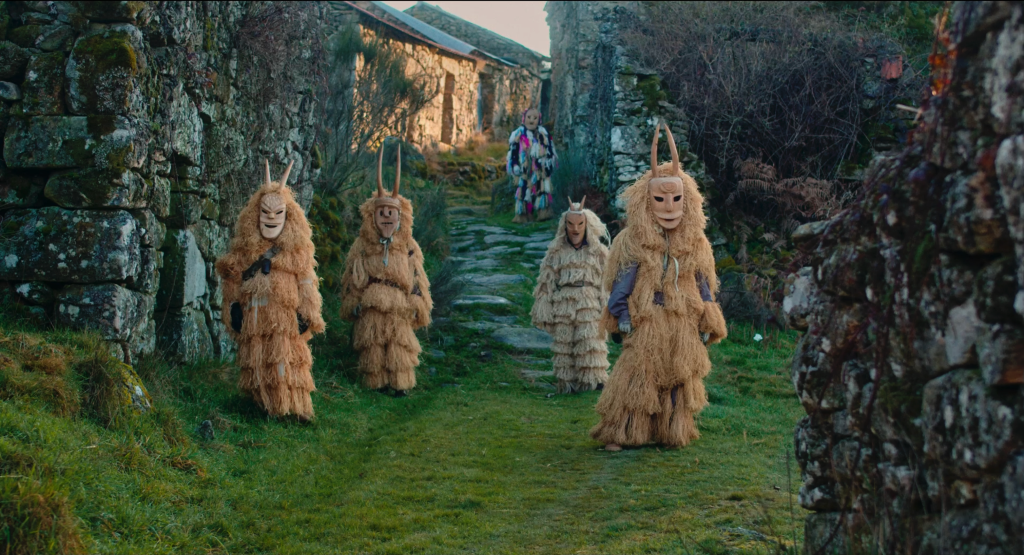
The Shrovetide Devil, by Diogo Varela Silva (2024 | Portugal | 52’)
Lazarim’s shrovetide is one of the most genuine and ancient carnival celebrations in Portugal. O Diabo do Entrudo explores the fascinating caretos and their elaborate costumes, enabling not only an overview of the carnival celebrations, but also a reflexion on gender dynamics and on the continuation of ancient customs handed down between generations in an ancient Portuguese village. One highlights the way in which rituals and traditions remain alive and are passed on from generation to generation, providing an intimate and rich perspective on the social and cultural changes over time.
It Was Dark Inside the Wolf, by Joana Botelho (2025 | Portugal | 30’)
Última Memória, a play by Sara Carinhas, premiered at Teatro São Luiz in March 2023. Estava Escuro na Barriga do Lobo is not its making of, but an incursion by Joana Botelho into Sara’s wandering doubts on her journey until the curtains open.
Pele Nómada, by João Fiadeiro and Aline Belfort (2025 | Portugal | 80’)
Pele Nómada is a film about memory and its displacements in the present. In the centre of a gentrified Lisbon, whose past is lost among facades lacking personality, João Fiadeiro carries moving boxes into a van. He takes with him everything that has been built up over his lifetime and that of atelier RE.AL, which will be taken to Serralves, where it will be archived. Before delivering the material to its final destination, João decides to visit all the places where RE.AL had its headquarters. This movement is a kind of farewell and, at the same time, a re -encounter. How will the past be in the future?
. Find the selection here
About CaixaForum+
CaixaForum+ is the “la Caixa” Foundation’s free streaming platform dedicated to promoting culture and science — a digital space offering over 1,200 hours of high-quality content, including music, the arts, literature, film, science, and philosophy, designed to make knowledge accessible to all audiences.


