


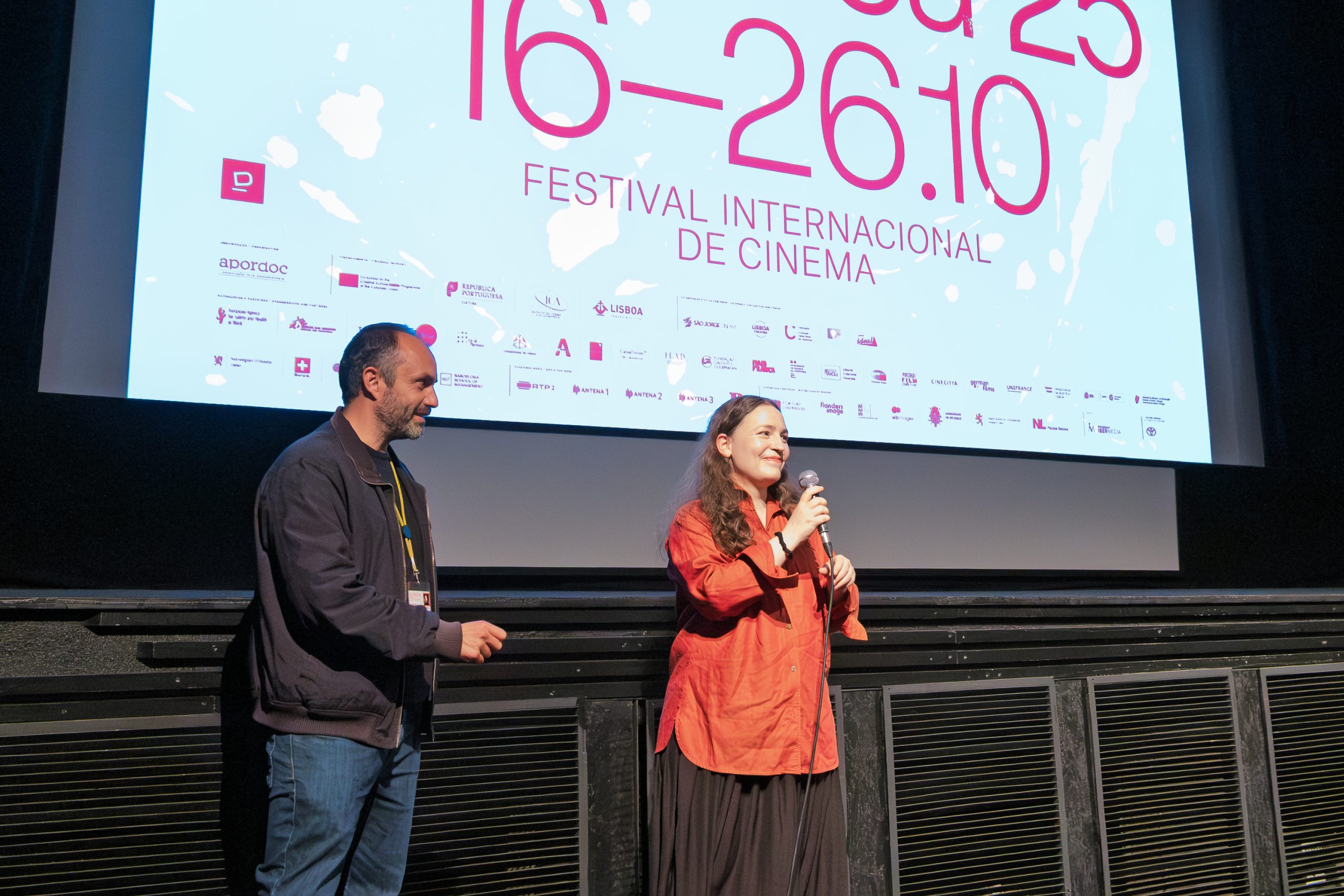
Isabel Pagliai Interview
Isabel Pagliai, director of the film Fantasy, which won the Médecins Sans Frontières – Portugal Award for Best Director in the International Competition at the 2025 edition of Doclisboa, tells us a little about her experience at the festival and the process of making this film.
Below is the interview we did in November:
1. First of all, congratulations on winning the Médecins Sans Frontières – Portugal Award for Best Director in the International Competition. What does this recognition mean to you at this stage of your career, and does the focus of this award resonate with the intentions behind Fantasy?
I don’t know exactly what the aim of this award is, but one thing’s for sure, I’m very happy about it! As it’s an award that focuses not only on the film itself but also on the director’s vision, I’d like to believe that it’s a kind of invitation to continue, to pursue the cinematic path I’m trying to chart. So yes, it touches me in that sense.
2. How has your experience at Doclisboa been, both as a filmmaker and as a guest in Lisbon?
I have been to Portugal before with my films, but this is the first time I have participated in Doclisboa. I was really delighted to meet the festival team and I felt that there was a great consistency, both as a viewer and as a director. It’s a festival that is warm, lively, and very sharp in its programming.
3. What was your approach to this film as a director, and how did you navigate the delicate boundary between reality, performance and imagination?
For me, these three dimensions are completely interconnected. They are different layers of work, but they are intertwined. The film begins with an encounter. And I have a desire to understand Louise in depth, that is, to know her reality but also to understand her imagination. And it is precisely all of this that determines the film’s trajectory: trying to capture her inner world in a visual form, while giving her an encounter that is more real than reality, through what I call a documentary dream.
Reality is the reality of what I saw in her, her despair. The fact that she was at a point in her life where she couldn’t move, couldn’t get going. She had a depressive relationship with the world. I would say that the performance lies in her writing and the way she recites her texts. This required support and a period of maturation that went well beyond the filming, involving back-and-forth editing. And imagination is what I am gradually coming to understand about her world: her relationship with water, touch, animals… These are things that already seem fictional, because of the way I film them, the play of light, and the plasticity of the images. All these things that I reinvest in my own way, and which allow me to envisage this second part of the dream in the forest
What was important was to take Louise somewhere else, to manage to move her. And so, to do that, I have several tools in my box, and all of that comes together during the different stages of the work. Louise’s reality and her condition are what we bring back through the documentary material, and then we readjust it and integrate it into the editing in a more fictional form. The film is the result of this interaction, this re-enactment of reality, which involves a reinvention, or rather a reappropriation of the rushes. But ultimately, the whole point of this work is to achieve a form of accuracy. As Jacques Nolot would say, “it has to ring true.”
We would like to thank Isabel Pagliai and the Médecins Sans Frontières – Portugal for their work and support for this award.


